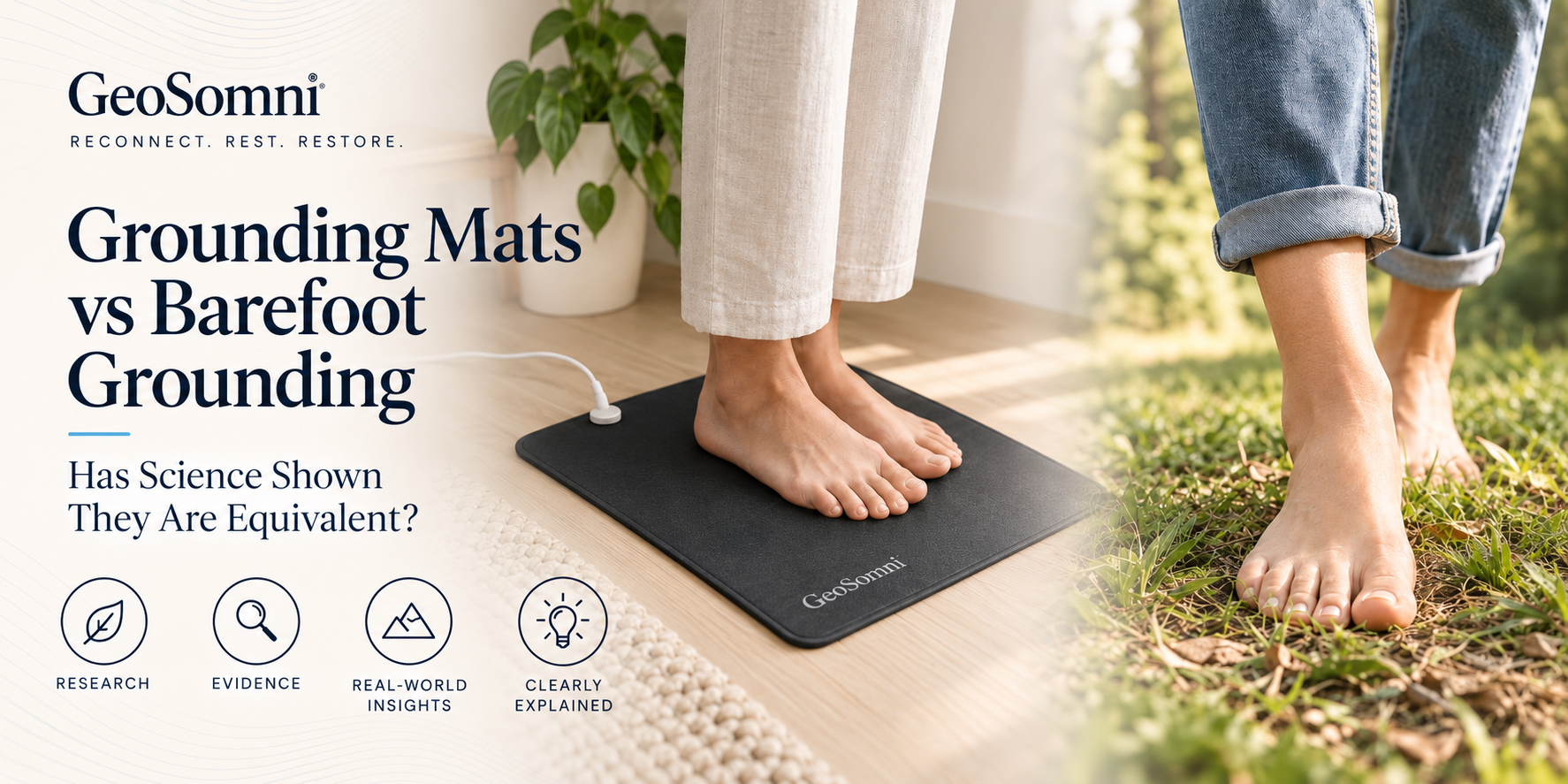

Grounding Mats vs Barefoot Grounding: Has Science Shown They Are Equivalent?
Grounding can be as simple as standing barefoot on the Earth. But much of the modern research on grounding has used something quite different: conductive mats, bed pads or skin patches connected to Earth ground.
That raises an obvious question.
If a grounding mat connects the body to ground, is that scientifically the same as going barefoot outside?
The short answer
Research has shown that indoor conductive grounding systems can electrically ground the human body, and several human studies using mats, bed pads and conductive patches have reported measurable physiological or other changes.
Direct barefoot grounding has also been studied.
What science has not yet established is that the two approaches are physiologically or clinically equivalent.
In other words, there is evidence that a properly connected indoor grounding system can establish an electrical connection between the body and Earth ground. But we could not identify a human trial directly comparing a grounding mat with barefoot Earth contact under matched conditions to determine whether they produce the same biological or health effects.
That distinction matters.
The scientific question is not simply: Can a grounding mat ground you?
There is experimental evidence that indoor conductive systems can do that electrically.
The harder question is:
Does grounding through a mat reproduce everything that happens when the body is directly in contact with the Earth?
At present, that remains an open research question.



What does “grounding” actually mean in the research?
The grounding literature generally includes two ways of connecting the human body to Earth.
The first is direct grounding: bare skin physically contacting a conductive natural surface, such as soil.
The second is indoor grounding: the body contacts a conductive mat, sheet, pad or electrode that is electrically connected to ground, either through a ground rod placed in the Earth or through the grounding system of an electrical outlet.
A 2012 review by Chevalier and colleagues discussed both approaches under the umbrella of “earthing” or “grounding,” describing indoor conductive systems as a way of simulating barefoot contact with the Earth.
But that description should not be mistaken for evidence that the two methods have been scientifically proven equivalent.
To understand why, it helps to separate three different questions:
Can the method electrically connect the body to ground?
Can the method produce measurable physiological changes?
Do different grounding methods produce equivalent physiological or clinical effects?
The research provides some evidence relevant to the first two.
The third has barely been tested.
What has research found with direct barefoot grounding?
One of the more relevant studies is a 2015 experiment by Teli and colleagues involving 53 people with prehypertension.
Participants were randomly allocated to either a barefoot-grounding group or a control group. The grounding group spent one hour barefoot in direct contact with the ground, without conductive patches or wires.
After the hour, the researchers reported significant reductions within the barefoot group in systolic, diastolic and mean blood pressure. No significant change was reported in the control group.
This is interesting because it demonstrates that direct barefoot Earth contact itself has been experimentally studied in humans.
However, the study was short, involved a relatively small group, and was not a blinded sham-grounding trial. It also measured blood pressure—not the electrical characteristics or biological outcomes measured in many indoor-grounding experiments.
So while it provides evidence relevant to barefoot grounding, it cannot tell us whether barefoot contact and a grounding mat produce the same effect.
Grounding mats have also been tested directly
Importantly, grounding mats are not simply an extrapolation from barefoot research.
They have been studied as an intervention in their own right.
A 2025 randomized, double-blind, placebo-controlled trial by Park and colleagues enrolled 60 participants, with 56 ultimately included in the analysis. Participants were assigned either a grounding mat or a visually similar non-grounding mat and instructed to use it for six hours per day over approximately one month.
The researchers assessed sleep using several questionnaires as well as actigraphy, which objectively estimates sleep and wake patterns.
Several questionnaire measures improved from baseline within the grounded group. More importantly when considering the controlled comparison, total sleep time measured by actigraphy increased significantly in the grounding group compared with the control group, and insomnia severity showed a significant between-group difference at follow-up.
Not every outcome showed a significant advantage over the control condition, so the results should not be interpreted as demonstrating improvement across every measure.
Still, the study is important for this particular question because it shows that a grounding mat itself can be studied using a randomized, sham-controlled design.
The study does not, however, tell us whether the same participants would have experienced identical changes from spending six hours barefoot on the Earth.
It was also a relatively small study, and the research was funded by World Home Dr. and Geosan Corp.; World Home Dr. supplied the grounding mat. The authors declared no known competing financial interests or personal relationships.
Can an indoor grounding system actually ground the body electrically?
This is where some of the older grounding experiments are particularly useful.
In a 2004 pilot study by Ghaly and Teplitz, 12 participants slept using conductive mattress pads connected by a grounding cord to an outdoor ground rod.
Before grounding, the participants' average measured 60-Hz electric-field-induced body voltage was 3.27 volts.
While lying on the grounded mattress pad, it fell to an average of 0.007 volts.
That works out to roughly:
3.27 ÷ 0.007 = 467
—approximately a 467-fold reduction in the measured induced body voltage.
The study also investigated cortisol patterns and subjective sleep, pain and stress over eight weeks. But for the mats-versus-barefoot question, the electrical measurement may be the most informative result.
It shows that an indoor conductive sleeping system connected to Earth ground can substantially change a measurable electrical characteristic of the body.
That is much more specific than simply assuming that a mat “works like the Earth.”
What about different types of indoor grounding systems?
Grounding research has not been limited to large mats.
A 2013 study by Chevalier and colleagues used conductive patches attached to the soles of the feet and palms of the hands. The patches were connected by wires to a stainless-steel rod inserted into the Earth outdoors.
Ten healthy adults were grounded for two hours.
Researchers measured the zeta potential of red blood cells—an electrical property related to the repulsive charge between cells—as well as red-blood-cell aggregation.
After grounding, the absolute zeta potential increased in all participants, by an average factor of 2.70, and the researchers reported less red-blood-cell clumping.
The paper interpreted these findings in relation to blood viscosity, but it is important to be precise: the experiment directly measured red-blood-cell zeta potential and aggregation, rather than directly measuring whole-blood viscosity with a conventional viscosity test.
For our current question, something else about the experiment is particularly interesting.
The participants were grounded through relatively small conductive patches rather than a large surface underneath the body.
That demonstrates that grounding research has produced measurable findings using very different types and sizes of conductive contact.
What it does not demonstrate is that those systems are interchangeable.
One experiment compared two indoor grounding methods
A particularly relevant technical study was published by electrical engineer Roger Applewhite in 2005.
Applewhite compared a conductive skin patch with a conductive bed pad while measuring 60-Hz voltage induced on the body by the surrounding electrical environment.
Both grounding methods reduced the measured induced voltage by a factor of at least 70.
That provides useful evidence that very different conductive interfaces can achieve the basic electrical outcome of grounding the body.
But there is an important limitation: Applewhite was both the researcher and the test subject.
This was essentially a single-person technical experiment, not a clinical trial. It also compared two indoor grounding devices, rather than comparing either device with direct barefoot Earth contact.
So the finding is useful, but narrow.
It tells us something about electrical grounding.
It does not establish biological equivalence.
Electrically grounded does not automatically mean biologically identical
This is probably the most important distinction in the entire discussion.
If a grounding mat and bare feet on the Earth both bring the body electrically toward Earth potential, it is tempting to conclude that they must therefore produce exactly the same physiological effects.
But that conclusion has not yet been experimentally demonstrated.
Consider the evidence we have:
Barefoot grounding has been associated with changes in blood pressure in one short human study.
A grounding mat has been studied in a randomized sham-controlled sleep trial.
Conductive mattress pads have substantially reduced measured induced body voltage.
Conductive patches have been associated with changes in red-blood-cell electrical properties and aggregation.
Different indoor conductive systems have successfully reduced induced body voltage.
Taken together, this makes indoor grounding systems scientifically interesting and gives researchers a practical way to study grounding under controlled conditions.
But the studies use different participants, durations, devices and outcome measures.
We cannot take a result from a barefoot blood-pressure experiment and assume a mat will necessarily reproduce it. And we cannot take a result from a grounding-mat sleep study and assume that walking barefoot for the same amount of time would necessarily produce an identical result.
Those comparisons still need to be tested.
Does the amount of skin contact matter?
This is another question that seems simple but remains surprisingly under-researched.
Barefoot grounding usually means contact through the soles of the feet. Grounding studies have also used small adhesive electrodes, larger sleeping pads and mats contacting different areas of the body.
Because measurable effects have been reported with more than one configuration, large contact area does not appear to be a prerequisite for conducting grounding research.
But the available studies do not establish whether increasing contact area changes the magnitude, speed or biological consequences of grounding.
Likewise, variables such as skin moisture, contact resistance, grounding-cord resistance, surface conductivity and grounding duration could conceivably affect electrical characteristics.
That does not mean they necessarily affect health outcomes.
The comparative studies required to answer those questions simply have not yet been done.
What does this mean for someone choosing between barefoot grounding and a mat?
The evidence supports a fairly straightforward interpretation.
Barefoot grounding is the most direct way to make physical contact with the Earth.
Indoor grounding systems provide a different practical route: conductive material connects the user's body to Earth ground while they remain indoors.
Experimental measurements show that such systems can substantially reduce induced body voltage, and grounding mats, sheets and patches have all been used in published human research.
So it would be inaccurate to suggest that grounding mats have no scientific basis simply because they are not the same physical experience as standing barefoot outside.
At the same time, it would go too far to claim that science has proven a grounding mat to be a perfect biological substitute for barefoot Earth contact.
The research has not made that comparison.
For consumers, perhaps the most defensible approach is therefore to look at the evidence for the specific method being considered, rather than assuming that every result from every form of grounding applies equally to every other form.
What study would actually answer the question?
A stronger test would directly compare the methods within the same experiment.
For example, researchers could randomly expose the same participants to:
direct barefoot Earth contact;
an active grounding mat;
a visually identical sham mat.
The sessions could be matched for duration and environmental conditions.
Researchers could then measure electrical outcomes—such as body voltage—alongside the same physiological outcomes in every condition.
A well-designed crossover trial could also test whether factors such as contact area or connection resistance materially change the response.
That would allow researchers to move beyond asking whether each method can produce some measurable effects and begin answering whether their effects are actually comparable.
The bottom line
Grounding mats and barefoot grounding both have a place in the published research, but science has not yet shown that they are physiologically or clinically equivalent.
There is good reason to distinguish that statement from saying grounding mats are unsupported.
Indoor conductive systems have been shown to electrically ground the body, including substantial reductions in measured induced body voltage. Human research has also reported measurable outcomes using grounding mats, mattress pads and conductive patches.
Direct barefoot grounding has independently been studied as well.
What is missing is the decisive experiment: a well-controlled human study directly comparing barefoot Earth contact with a grounding mat using the same participants, exposure duration and outcome measures.
Until that study exists, the evidence supports cautious optimism rather than certainty.
Grounding mats are a genuine method used in grounding research. Barefoot contact is another.
Whether the two produce fully equivalent biological effects remains a question for future research.
Research references
Park H-J, Lee GR, Kim Y, et al. (2025). A randomized, double-blind, placebo-controlled study on the improvement of sleep quality with Earthing mat. Advances in Integrative Medicine, 12(3), 100458. DOI: 10.1016/j.aimed.2025.01.005.
Teli SS, Velou MS, Paramasivam L, Divya D. (2015). An experimental study on immediate effect of direct barefoot contact with earth on prehypertension. International Journal of Medical Research and Review, 3(8), 836–840. DOI: 10.17511/ijmrr.2015.i8.157.
Ghaly M, Teplitz D. (2004). The biologic effects of grounding the human body during sleep as measured by cortisol levels and subjective reporting of sleep, pain, and stress. Journal of Alternative and Complementary Medicine, 10(5), 767–776. DOI: 10.1089/acm.2004.10.767.
Chevalier G, Sinatra ST, Oschman JL, Delany RM. (2013). Earthing (grounding) the human body reduces blood viscosity—a major factor in cardiovascular disease. Journal of Alternative and Complementary Medicine, 19(2), 102–110. DOI: 10.1089/acm.2011.0820.
Applewhite R. (2005). The effectiveness of a conductive patch and a conductive bed pad in reducing induced human body voltage via the application of earth ground. European Biology and Bioelectromagnetics, 1, 23–40.
Chevalier G, Sinatra ST, Oschman JL, Sokal K, Sokal P. (2012). Earthing: Health implications of reconnecting the human body to the Earth's surface electrons. Journal of Environmental and Public Health, 2012, 291541. DOI: 10.1155/2012/291541.