The Definitive Guide to Grounding Mats:
How They Work, What the Research Says, and How to Use Them Safely
Evidence reviewed: August 2026
Grounding mats—also called earthing mats—are conductive products designed to create an indoor electrical connection between the body and Earth. A grounding floor mat is a compact form commonly used beneath bare feet at a desk, while sitting or resting, or in bed where the product is approved for that use.
The electrical connection created by grounding is measurable. The possible health effects are less certain.
Small human studies have investigated grounding in relation to sleep, cortisol, pain, mood, exercise recovery and selected physiological measures. Some have reported favourable findings, including a 2025 randomized, double-blind, placebo-controlled sleep trial. However, the overall clinical evidence remains preliminary, and grounding has not been established as a treatment for insomnia, chronic pain, inflammation or other medical conditions.[1]
In this guide, grounding floor mat refers to a wellness earthing mat designed for body contact—not an industrial antistatic or ESD mat used to protect electronics.
Grounding Mats: The Bottom Line
The electrical connection is real. A conductive mat connected to a functioning ground can change the body’s measured electrical relationship with Earth.
The health evidence is promising in places, but inconclusive. Small studies have reported favourable findings involving sleep, cortisol, pain, mood, recovery and selected physiological measures. Most remain limited by modest samples, limited independent replication or reliance on subjective outcomes.
Sleep has some of the strongest emerging evidence. A 2025 controlled pilot involving 60 participants reported greater actigraphy-estimated total sleep time in the active-grounding group than in the control group.[1]
Grounding is not a proven medical treatment. Current research does not establish grounding as a treatment for insomnia, chronic pain, chronic inflammation, hypertension, cardiovascular disease or other medical conditions.
Trying grounding is a personal decision. Interested users should use correctly designed equipment, test the outlet, follow the product instructions and keep expectations realistic.
Table of Contents
What does grounding mean?
In this guide, grounding—also called earthing—means creating a conductive electrical connection between the body and Earth. This is different from psychological “grounding techniques,” which redirect attention to the present moment.
Outdoor grounding
Outdoor grounding occurs when bare skin contacts a conductive natural surface such as soil, grass, sand or water. Conductivity varies with surface conditions, moisture and footwear.
Indoor grounding
Indoor grounding products are designed to provide a conductive Earth connection when outdoor contact is inconvenient. They include grounding mats, sheets, mattress covers, desk mats, patches and bands.
Is grounding the same as earthing?
In consumer wellness discussions, the terms generally refer to the same practice. “Earth” is more common in Australia and the United Kingdom; “ground” is more common in the United States.
What is a Grounding Mat?
A grounding mat is a conductive surface designed to connect exposed
skin to Earth through a grounding cord. A typical product includes a
conductive upper surface, stable backing, connection point, cord and
ground-only plug.
What Is a Grounding Floor Mat?
A grounding floor mat is a type of grounding mat designed for convenient placement beneath the feet or another area of exposed skin. The term describes its format and common placement rather than a regulated product category.
Wellness mats and industrial ESD mats are different
Industrial ESD mats protect electronic equipment from electrostatic discharge. Wellness grounding mats are intended for body contact. They may share electrical concepts, but they serve different purposes and should not be treated as interchangeable.
Grounding mat versus grounding sheet
A floor mat provides a smaller, targeted contact area and may be easier to move and clean. A grounding sheet provides a larger bed surface. Current research does not establish that one format creates greater health benefits.
How Do Grounding Mats Work?
A grounding mat works by creating a conductive path between its surface and Earth. When the surface, cord, outlet ground and skin contact are functioning correctly, the user’s electrical potential can move closer to Earth potential.
Connecting the body to ground can change measured body voltage
under tested conditions. This demonstrates an electrical effect. It
does not by itself demonstrate improved sleep, reduced pain or
another health outcome.[11]
Grounding can create a genuine, measurable electrical connection without every proposed health benefit being scientifically established.
Does charge move between the body and Earth?
A conductive connection allows charge to move in response to differences in electrical potential. Proposed electron-transfer, antioxidant and anti-inflammatory mechanisms remain hypotheses rather than established clinical explanations.[15]
What a grounding mat does not do
A correctly designed ground-only mat does not generate electricity, heat up, provide powered stimulation or connect to the outlet’s live and neutral contacts.
Does a Grounding Mat Use Electricity?
A ground-only grounding mat is not intended to draw operating power from the live electrical supply. The GeoSomni cord’s single round pin enters only the grounding opening of a standard US three-prong receptacle.
Why does it plug into an outlet?
A correctly wired grounded outlet provides a convenient indoor connection to the building’s protective-ground system. The outlet should be tested first because a three-prong receptacle does not guarantee a functioning ground.
Do Grounding Mats Actually Work?
Do they work electrically?
Yes—when the surface is conductive, the cord and connectors are intact, the outlet has a functioning ground and the user makes conductive contact with the mat.
Do they reliably improve health?
That remains uncertain. Some human studies have reported favourable findings involving sleep, cortisol, pain, mood, exercise recovery and selected blood or physiological measures. Much of the literature consists of small pilot studies with limited replication.
Grounding mats create a real electrical
connection. Evidence that this connection reliably produces
meaningful health benefits is encouraging in places but remains
inconclusive.
Are grounding mats scientifically proven?
Grounding is scientifically measurable and has been studied in humans. Its proposed health benefits have not been confirmed to the standard required to call grounding a proven medical treatment.
Is grounding a scam?
Grounding is a real electrical phenomenon, but that does not validate every health claim made about grounding products. Distinguish the measurable connection, preliminary clinical research and marketing claims that go beyond the evidence.
Is grounding just a placebo?
The electrical connection itself is measurable. Subjective outcomes such as sleep quality, pain, stress and mood can still be influenced by expectation, routine changes and placebo effects. Sham-controlled trials are therefore important.
Can Grounding Mats Help With Sleep?
Possibly. Sleep is one of the more encouraging areas of grounding research, but the evidence is not strong enough to describe grounding as a proven sleep treatment.
The 2025 randomized sleep study
A randomized, double-blind, placebo-controlled pilot involved 60 participants who used either an active earthing mat or a non-grounding control for six hours per day over 31 days. The active group showed a statistically significant increase in actigraphy-estimated total sleep time compared with the control group. At day-38 follow-up, the active group also had more favourable Insomnia Severity Index scores.[1]
The trial is stronger than most earlier grounding studies because it used randomization, a control, blinding and an objective estimate of sleep duration. It remains one modest pilot and does not establish increased deep sleep, REM sleep, melatonin, circadian resetting, permanent benefit or treatment of clinical insomnia.
The 2004 sleep and cortisol study
A 12-person uncontrolled pilot reported changes in nighttime cortisol patterns and improvements in self-rated sleep, pain and stress during grounded sleep.[2] The lack of randomization, sham control and objective sleep-stage measurement makes the findings preliminary.
Mild Alzheimer’s pilot
A 2022 pilot reported improved questionnaire-based sleep scores among people with mild Alzheimer’s disease, without significant improvements in anxiety or depression.[3] Its generalizability to ordinary grounding-mat buyers is limited.
Deep sleep, insomnia, circadian rhythm and melatonin
Current human evidence does not establish that grounding increases deep sleep, treats diagnosed insomnia, resets circadian rhythm or increases melatonin. Actigraphy estimates sleep and wakefulness from movement; it does not directly measure detailed sleep stages.
How long does grounding take to affect sleep?
Research has not established a reliable timeframe or optimal daily duration. Published studies use different products, schedules, populations and outcome measures.
Bottom line: The human sleep evidence is
encouraging but not conclusive. The 2025 controlled pilot reported a
favourable result in estimated total sleep time, while earlier
studies reported subjective sleep or cortisol changes.
Grounding Mats and Pain
Small human studies have examined grounding in relation to pain, exercise-induced soreness and physical function. Some reported favourable findings. Grounding has not been established as a treatment for chronic pain, arthritis, fibromyalgia or injury.
Exercise-induced soreness
Three small controlled studies examined grounding after eccentric exercise. They reported differences in selected pain, creatine kinase, blood-cell or performance measures, but involved small samples and differing protocols.[5][6][7]
Massage therapists
A six-week trial involving 16 massage therapists reported improvements in several self-rated pain, physical-function and mood domains during grounded periods.[8] The small sample, many outcomes and reliance on self-report limit the conclusion.
Bottom line: Some small studies reported favourable pain or function findings. Grounding is not an established chronic-pain treatment.
Do Grounding Mats Reduce Inflammation or Speed Recovery?
Preliminary exercise studies reported changes in creatine kinase, blood-cell counts and selected inflammation-related measures. These findings do not establish grounding as an anti-inflammatory treatment or prove that it reliably speeds recovery.
The frequently cited 2015 inflammation paper is a narrative review and hypothesis article drawing on small experiments, case observations and proposed mechanisms—not a large controlled clinical trial.[15]
Bottom line: Grounding has been studied in relation to selected recovery and inflammation-related measures, but clinical reduction of chronic inflammation is not established.
Grounding, Stress, Cortisol and Mood
The 2004 sleep pilot reported changes in overnight cortisol patterns, but its uncontrolled design could not establish causation.[2]
A 2015 double-blind pilot involving 40 adults reported greater short-term improvement in selected positive mood scores after one hour of grounding than after sham grounding.[4] It did not assess treatment of anxiety or depression or determine whether changes persisted.
Small studies have also observed short-term changes in selected autonomic measurements, but the clinical meaning and durability remain uncertain.[10]
Bottom line: Preliminary studies reported favourable changes in short-term mood, subjective stress, cortisol patterns and selected physiological measures. Grounding is not an established mental-health or stress-treatment intervention.
Does Grounding Improve Circulation or Blood Flow?
A 10-person uncontrolled study reported changes in red-blood-cell zeta potential and aggregation after two hours of grounding.[9] It did not demonstrate improved tissue blood flow, fewer clots, reduced cardiovascular events or lower cardiovascular risk.
The phrase “grounding thins the blood” should be avoided because it implies a predictable anticoagulant or medication-like effect that the research did not establish.
A small uncontrolled hypertension case series cannot establish grounding as a blood-pressure treatment.[13]
Bottom line: Current evidence does not establish that grounding improves circulation, prevents blood clots or reduces cardiovascular risk.
How Strong Is the Scientific Evidence for Grounding?
The evidence is neither nonexistent nor conclusive.
The electrical connection is measurable. The clinical evidence contains encouraging signals—particularly in emerging sleep research—but remains preliminary.
Why the evidence remains preliminary
Many studies are small, independent replication is limited, overlapping researchers appear across the literature, some studies measure numerous outcomes and several important outcomes are subjective. Objective measurements may still be indirect: lower body voltage does not prove better sleep; changed creatine kinase does not necessarily mean faster recovery; changed red-cell aggregation does not prove improved circulation.
The GeoSomni Evidence Position
Grounding is electrically real and scientifically testable. Human research has produced encouraging findings—most notably in emerging sleep research—but the evidence remains too limited to guarantee benefits or describe grounding as a proven medical treatment.
Is a Grounding Mat Worth Trying?
Grounding is not a guaranteed sleep aid, pain treatment or anti-inflammatory therapy. Some users report meaningful benefits, while others notice little or no change.
A personal trial may be reasonable for someone who understands the evidence limits, uses the product correctly and does not abandon appropriate medical care.
Personal experiences are useful—but not proof
Customer reviews describe what individuals believe they experienced. They cannot establish causation, frequency of benefit or whether another person will have the same result.
A practical personal assessment
For sleep, users may record bedtime, wake time, estimated sleep latency, awakenings, perceived sleep quality and morning energy while noting major changes in illness, stress, caffeine, alcohol or medication. This can guide a personal decision but does not create scientific proof.
Warranty
Requests within Amazon’s applicable return window should be submitted through the customer’s Amazon account. The GeoSomni Grounding Floor Mat includes a 12-month manufacturer’s warranty covering defects in materials or workmanship under normal use.
How to Use a Grounding Mat
1. Inspect the mat and cord
Check for tears, exposed wire, crushing, severe kinks, loose connectors, damaged pins or moisture. Do not use damaged equipment.
2. Test the outlet
Plug in the included tester. For the supplied GeoSomni tester, the correct indication is two amber lights illuminated and the red light off. If another pattern appears, do not connect the mat.
A basic three-light tester identifies several common wiring conditions but cannot detect every possible fault or certify the entire electrical installation.
3. Connect to the grounding port
Plug the other end of the grounding cord into the round/U-shaped grounding hole of the tested wall outlet. The grounding hole may be above or below the two flat power slots.
4. Connect the cord to the mat
Press the cord connector securely onto the mat’s press stud. Avoid pulling or dragging the mat by the cord.
5. Make direct skin contact
Bare feet, a hand, forearm or another exposed area can contact the conductive surface. Direct skin contact provides the most reliable connection.
Do socks, clothing or sheets interfere?
Dry, thick or synthetic fabric can reduce or interrupt conductivity. A thin covering may conduct under some conditions, but direct skin contact is the most predictable approach.
Can you feel the mat working?
Usually not. A grounding mat is not intended to produce tingling, warmth, pulsing or electrical stimulation. Feeling nothing does not prove either success or failure.
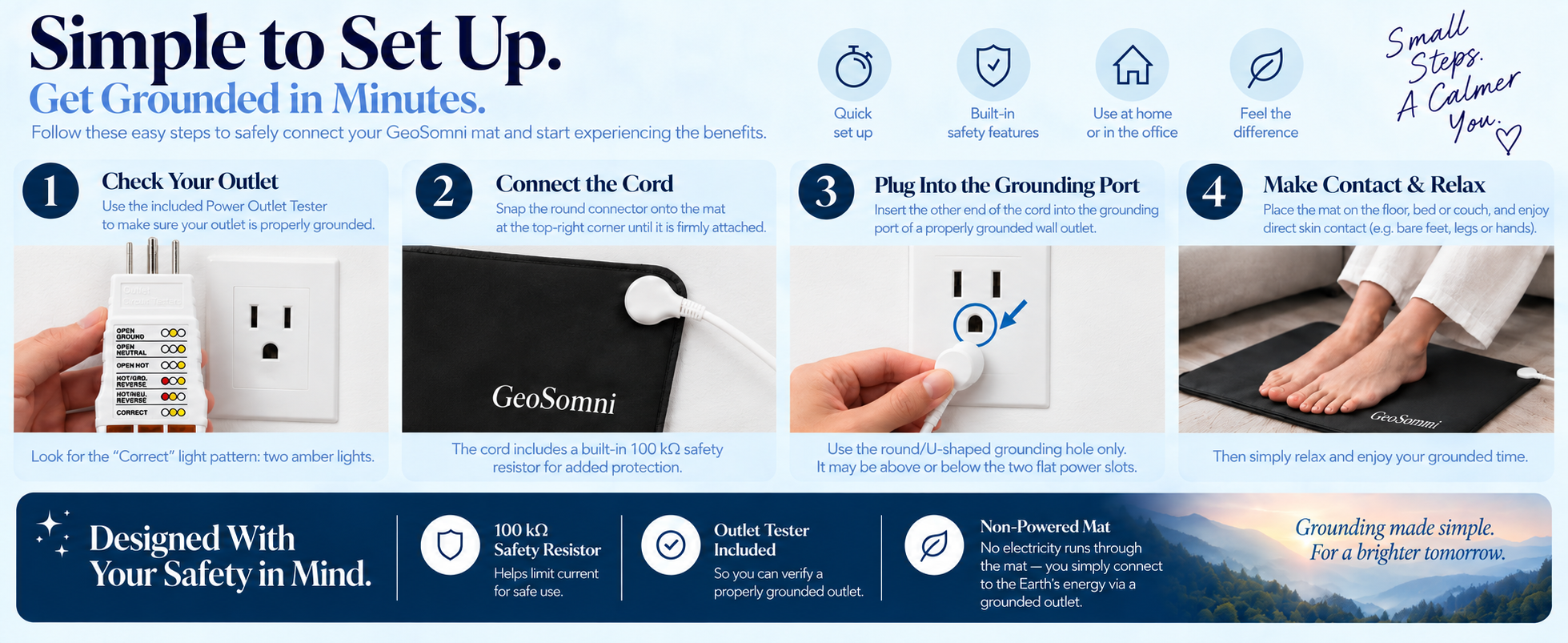
Grounding Cords and Resistance
The manufacturer states that the GeoSomni cord incorporates
resistance within the range of 10³–10⁵ ohms, equivalent
to approximately 1–100 kΩ.
Important Safety Tips
Extension cords and power boards
It is best practise to connect directly to a wall outlet rather than through an extension cord or power board.
RV or caravan use
Use only with a correctly grounded AC outlet that passes the supplied outlet tester. Do not use with ungrounded outlets or electrical systems where a proper protective ground is unavailable. If using an RV, generator, inverter or other non-standard power system, confirm that the outlet provides a proper equipment ground before use.
Thunderstorms
It is best practise to disconnect the grounding cord from the wall outlet during thunderstorms or when lightning is nearby. Cord resistance is not lightning protection.
Overnight cord routing
Route the cord so it cannot wrap around the body, become accessible to a child or pet, create a trip hazard, become trapped beneath furniture or pull continuously against the press stud.
Cleaning and Storage
Cleaning
Disconnect the cord. Wipe the mat with a damp cloth and mild soap if needed. Do not soak or machine-wash it. Avoid harsh cleaners and allow it to air-dry completely before reconnecting.
Storage
Store the mat flat or loosely rolled in its storage tube. Avoid sharp folds, tight creases, heavy pressure and strain on the connector.
How to Choose a Grounding Mat
Look for a clearly identified conductive surface, a ground-only connection, an included outlet tester, accurate cord specifications, adequate cord length, stable backing, clear care instructions, transparent materials information, realistic health claims and clear warranty/support terms.
Be cautious with broad claims such as “completely non-toxic,” “medical-grade,” “clinically proven,” “detoxifying,” or guaranteed treatment of insomnia, inflammation, pain or circulation problems.
About the GeoSomni Grounding Floor Mat
Size: 24 × 16 inches
Surface: conductive PU
Backing: rubber-backed mat construction
Cord: 15 feet, single-pin ground-only US plug
Resistance: manufacturer-stated 10³–10⁵ ohms
Outlet tester: included
Storage: storage tube
Warranty: 12 months for defects in materials or workmanship under normal use
A submitted sample identified as conductive PU leather received a pass result for the substances and limits covered by the supplied RoHS report.
Ready to Explore Grounding?
The GeoSomni Grounding Floor Mat includes a compact conductive surface, 15-foot ground-only cord, outlet tester and 12-month manufacturer’s warranty.
View the GeoSomni Grounding Floor Mat on Amazon
Purchases made through Amazon are subject to Amazon’s applicable return arrangements. Manufacturing faults identified after that return window but within 12 months of purchase may be addressed directly by GeoSomni, subject to the warranty terms.
Grounding Mat FAQs
How do grounding mats work?
Grounding mats are conductive surfaces designed to connect the body to the Earth’s electrical ground through a grounded outlet or grounding rod. When the system is functioning correctly and your skin is in contact with the mat, your body becomes electrically connected to ground.
Do grounding mats actually work?
They create a measurable electrical connection when the complete setup is functioning correctly. Whether they reliably improve health requires further ongoing research.
Can grounding mats help with sleep?
Possibly. A 2025 controlled pilot reported greater estimated total sleep time in the active group, but larger independent trials are needed.[1]
What is a grounding mat?
A grounding mat, also called an earthing mat, is a conductive mat designed to create an electrical connection between your body and the Earth’s ground. It is commonly used under bare feet at a desk, beside a bed, or in other seated or resting positions.
Are grounding mats safe?
A grounding mat should only be used with a properly grounded electrical system and according to the manufacturer’s instructions. It should connect only to the grounding component of the system and should not draw operating power from live electricity. If you are unsure whether an outlet is correctly grounded, test it before use.
Do grounding mats increase deep sleep?
Current research does not establish that grounding mats increase deep sleep specifically. Some studies have reported improvements in overall sleep measures or subjective sleep quality, but the evidence is still limited and does not demonstrate a reliable increase in deep-sleep duration.
How long does grounding take to work?
There is no scientifically established timeframe.
Does a grounding mat use electricity?
A grounding mat is not intended to draw operating power from live
electricity.
How do I know whether my outlet is correctly grounded?
Use the included tester. The correct GeoSomni tester indication is both amber lights on and the red light off.
Do I need bare feet?
Bare skin provides the most reliable conductive connection.
Can I use an extension cord?
It is best practice to connect directly to a wall outlet rather than through an extension cord or power board.
Can I use the mat in an RV?
Use only with a correctly grounded AC outlet that passes the supplied outlet tester. Do not use with ungrounded outlets or electrical systems where a proper protective ground is unavailable. If using an RV, generator, inverter or other non-standard power system, confirm that the outlet provides a proper equipment ground before use.
Can I use it during a thunderstorm?
No. Disconnect it from the wall outlet when lightning is nearby.
Do grounding mats reduce inflammation?
This has not been established as a clinical outcome.
Do grounding mats improve circulation?
Current evidence does not establish improved circulation or reduced
cardiovascular risk.
Can grounding replace medical care?
No.
References
Park HJ, Lee GR, Kim Y, et al. A randomized, double-blind, placebo-controlled study on the improvement of sleep quality with Earthing mat. Advances in Integrative Medicine. 2025;12(3):100458. doi:10.1016/j.aimed.2025.01.005.
Ghaly M, Teplitz D. The biologic effects of grounding the human body during sleep as measured by cortisol levels and subjective reporting of sleep, pain, and stress. J Altern Complement Med. 2004;10(5):767–776. doi:10.1089/acm.2004.10.767.
Lin CH, Tseng ST, Chuang WH, et al. Grounding the body improves sleep quality in patients with mild Alzheimer’s disease: a pilot study. Healthcare. 2022;10(3):581. doi:10.3390/healthcare10030581.
Chevalier G. The effect of grounding the human body on mood. Psychological Reports. 2015;116(2):534–542. doi:10.2466/06.PR0.116k21w5.
Brown D, Chevalier G, Hill M. Pilot study on the effect of grounding on delayed-onset muscle soreness. J Altern Complement Med. 2010;16(3):265–273. doi:10.1089/acm.2009.0399.
Brown R, Chevalier G, Hill M. Grounding after moderate eccentric contractions reduces muscle damage. Open Access J Sports Med. 2015;6:305–317. doi:10.2147/OAJSM.S87970.
Müller E, Pröller P, Ferreira-Briza F, Aglas L, Stöggl T. Effectiveness of grounded sleeping on recovery after intensive eccentric muscle loading. Front Physiol. 2019;10:35. doi:10.3389/fphys.2019.00035.
Chevalier G, Patel S, Weiss L, Chopra D, Mills PJ. The effects of grounding on bodyworkers’ pain and overall quality of life: a randomized controlled trial. Explore. 2019;15(3):181–190. doi:10.1016/j.explore.2018.10.001.
Chevalier G, Sinatra ST, Oschman JL, Delany RM. Earthing—grounding the human body—reduces blood viscosity, a major factor in cardiovascular disease. J Altern Complement Med. 2013;19(2):102–110. doi:10.1089/acm.2011.0820.
Chevalier G. Changes in pulse rate, respiratory rate, blood oxygenation, perfusion index, skin conductance, and their variability induced during and after grounding human subjects for 40 minutes. J Altern Complement Med. 2010;16(1):81–87. doi:10.1089/acm.2009.0278.
Brown R. Effects of grounding on body voltage and current in the presence of electromagnetic fields. J Altern Complement Med. 2016;22(9):757–759. doi:10.1089/acm.2015.0340.
Passi R, Doheny KK, Gordin Y, Hinssen H, Palmer C. Electrical grounding improves vagal tone in preterm infants. Neonatology. 2017;112(2):187–192. doi:10.1159/000475744.
Elkin HK, Winter A. Grounding patients with hypertension improves blood pressure: a case history series study. Altern Ther Health Med. 2018;24(6):46–50.
Chevalier G, Sinatra ST, Oschman JL, Sokal K, Sokal P. Earthing: health implications of reconnecting the human body to the Earth’s surface electrons. J Environ Public Health. 2012;2012:291541. doi:10.1155/2012/291541.
Oschman JL, Chevalier G, Brown R. The effects of grounding on inflammation, the immune response, wound healing, and prevention and treatment of chronic inflammatory and autoimmune diseases. J Inflamm Res. 2015;8:83–96. doi:10.2147/JIR.S69656.